
Search Images
Browse Content (p. 1384)
Image
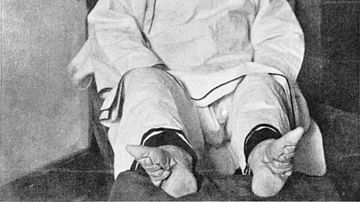
Woman with Bound Feet
A Chinese woman of the early 20th century CE with feet made smaller by the ancient practice of foot-binding. (From 'Women Of All Nations' published by Underwood & Underwood, 1911)
Image
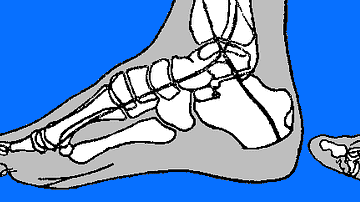
The Effects of Foot-binding on the Foot Bones
A diagram showing the effect on the bones of the foot from the ancient Chinese practice of foot-binding.

Image
Chinese Shoe for a Bound Foot
A Chinese silk shoe designed to be worn by a woman with bound-feet. 18th century CE. (Musées du château des Rohan, Musée Louise Weiss, Saverne, France)

Image
Odes of Horace
Odes of Horace. Illuminated by William Morris c. 1873 CE from the Collected Works of William Morris Vol. XI.
Image
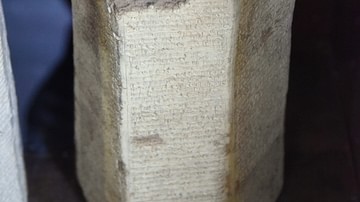
Assyrian Prism of Esarhaddon
Hexagonal clay prism with cuneiform inscription narrating the military campaigns of the Assyrian king Esarhaddon (r. 680-669 BCE). Later on, the upper aspect was used a candle holder by the owner. Probably from Nineveh...
Image
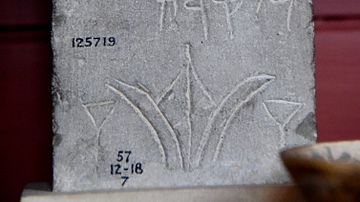
Phoenician Stela Dedicated to Tanit & Baal-Hammon
This light grey limestone stela was inscribed with six lines of Phoenician/Punic inscription; the upper line is almost lost. There is a lotus flower flanked by two standards at the lower part. There...
Image
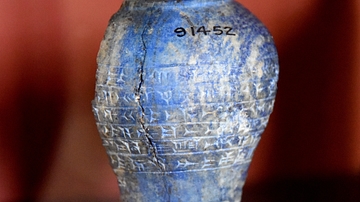
Portion of a Lapis Lazuli Head-Mace from the Temple of Ninurta
This fragment of a lapis lazuli Head-mace was inscribed with six lines of cuneiform inscriptions. The name of Ashurnasirpal II (reigned 884-859 BCE) was mentioned in this dedicatory text. Neo-Assyrian...

Image
Emperor Taizu
A 10th century portrait on a hanging silk scroll of Taizu, first emperor of the Song dynasty in China, r. 960-976. The extensions on the emperor's black gauze cap symbolise his power and dignity.
National Palace Museum, Taipei.

Image
Travelling among Streams & Mountains by Fan Kuan
Travelling among Streams & Mountains by Fan Kuan (c. 990-1030 CE). Song Dynasty. Painted silk, 2 x 1 metres. (National Palace Museum, Taipei)

Image
Northern Song Dynasty Map
A map indicating the territory of the Northern Song Dynasty of China, 960-1125 CE.
