
Search Images
Browse Content (p. 1391)
Image
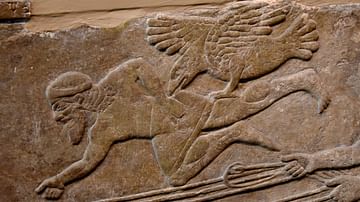
Predator Bird Attacks a Soldier
Alabaster bas-relief showing a vulture attacking a dead enemy soldier, who was killed by the Assyrian army. Neo-Assyrian Period, 865-860 BCE. Detail of Panel 3 (bottom), Room B, the North-Palace Palace, Nimrud, modern-day...

Image
Vulture Attacking a Dead Soldier
Alabaster bas-relief showing a vulture pecking an eye of a soldier who was killed by the Assyrian army. Neo-Assyrian Period, 865-860 BCE. Detail of Panel 11 (top), Room B, the North-Palace Palace, Nimrud, modern-day...

Image
Assyrian War Relief Panel, Nimrud
Alabaster bas-relief showing Assyrian soldiers playing catch with decapitated heads of their enemies. Neo-Assyrian Period, 865-860 BCE. Detail of Panel 6 (top), Room B, the North-Palace Palace, Nimrud, modern-day...
Image
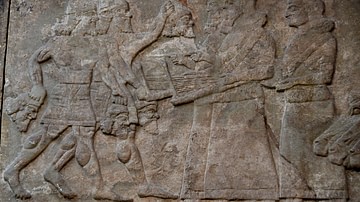
Decapitated Heads of Assyrian Enemies
Alabaster bas-relief showing Assyrian soldiers holding the decapitated heads of their defeated enemy before Assyrian musicians. Neo-Assyrian Period, 865-860 BCE. Detail of Panel 6 (top), Room B, the North-Palace...
Image
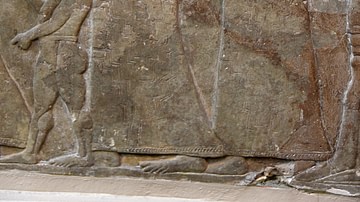
Assyrian Prisoners of War
Alabaster bas-relief showing two women and a child as prisoners of war after the Assyrian army captured their city, detail of Panel 5 (bottom), Room B, the North-Palace Palace, Nimrud, modern-day Iraq, Neo-Assyrian Empire...
Image
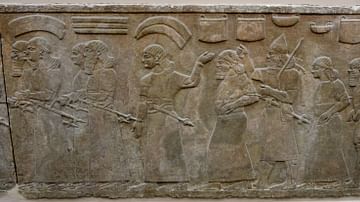
Prisoners of War & Booty
Alabaster bas-relief showing a procession of prisoners of war and booty led by Assyrian soldiers and officials. Neo-Assyrian Period, 865-860 BCE. Detail of Panel 17 (bottom), Room B, the North-Palace Palace, Nimrud, modern-day...

Image
Ashurnasirpal II After Winning a Battle
Alabaster bas-relief showing Ashurnasirpal II greeted by his commander-in-chief, awaiting to review prisoners of war and receiving booty after a successful military campaign capturing a city. Neo-Assyrian Period...

Image
Samovar, Pompeii
A samovar was used to serve warm liquids. Charcoal in the hollow centre of the vessel heated the water within the double wall. The liquid then came out of a tap decorated as a head of an eastern barbarian. Three suspension terminals...

Image
Amphora Stoppers, Comacchio Shipwreck
Four ceramic amphora stoppers from the Comacchio Shipwreck. 25-1 BCE. Museo della Nave di Comacchio, (photo taken at the National Maritime Museum, Sydney, Australia)
Image
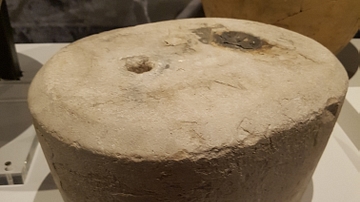
Stone Weight From The Comacchio Shipwreck
A Centussis weight used to weigh the cargo for sale. The stone is inscribed with an 'M' for Magister Navis, the ship's master and the initials 'TRVF', possibly for his name - either Titus Rufius or Titus Rufrenius...
