
Search Images
Browse Content (p. 1448)
Image
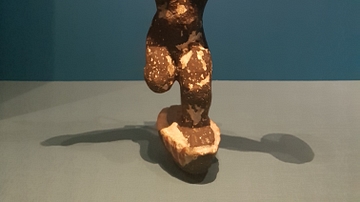
Statue Of Bes
Statue of Bes. Probably late 18th Dynasty, about 1300 BCE. Said to be from Akhmim, Egypt. From The British Museum, (photo taken at The Powerhouse Museum, Sydney, Australia) Several gods were associated with music, including...
Image
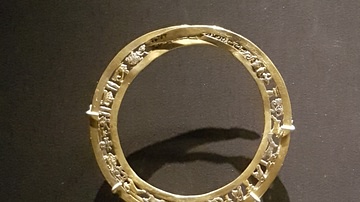
Egyptian Gold & Silver Bangle
Egyptian gold and silver bangle. Middle Kingdom of Egypt, c. 2055-1650 BCE. This bangle is decorated with alternating animal and amuletic motifs. They all have protective meanings: a snake seizes a turtle, a symbol...
Image
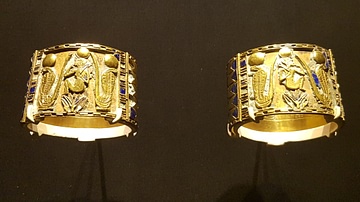
Egyptian Gold Bracelets
Egyptian inlaid gold bracelets belonging to Prince Nimlot, one of the sons of Sheshonq I, the first king of the 22nd Dynasty. About 940 BCE. Said to be from Sa el-Haggar (Sais), Egypt. From The British Museum, (photo taken...
Image
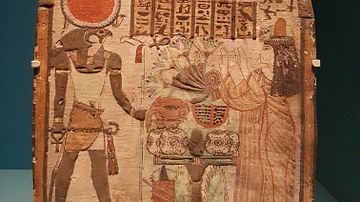
Funerary Stela of Deniuenkhonsu
Wooden funerary stela of Deniuenkhonsu, Singer of Amun-Ra. 22nd Dynasty, about 800 BCE. Probably from Thebes, Egypt. The British Museum, (photo taken at The Powerhouse Museum, Sydney, Australia) Deniuenkhonsu is...

Image
Susanoo & the Dragon
Wooden screen depicting the Shinto god Susanoo defeating the dragon with eight heads, 19th century. Susanoo was the god of storms and Yomi, the underworld.
Crow Collection of Asian Art, Dallas, Texas.

Image
Barque of Ra
The solar barque of Ra. Outer Coffin of Isetemkheb D (Royal Cache TT 320, Deir el-Bahari), Egyptian Museum, CG 610031.
Image
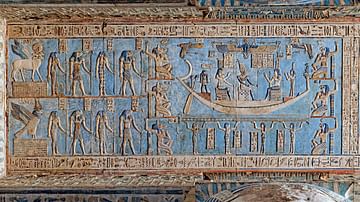
Dendera Temple Ceiling
Osiris, seated on a throne, sails across the sky as the personification of the full moon, accompanied by the seated goddesses Nephthys on left and Isis on the right; Ma'at stands near the bow of the ship.
Image
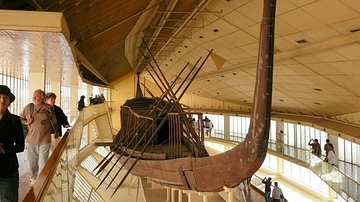
Khufu's Ship
This boat was found practically intact; except for one oar, it was in remarkable condition. Built for Khufu, the ship was sealed into a pit in the Giza pyramid complex at the foot of the Great Pyramid of Giza.

Image
Ovid Exiled
16th-century CE edition of Ovid's Tristia from Venice.
Penn Libraries, Rare Book Collection

Image
Ovid
Statue of Ovid in Constanta, Romania, where he spent his later years in exile.
