
Search Images
Browse Content (p. 1499)

Image
Later Three Kingdoms Period
A map showing the political geography of Korea during the Later Three Kingdoms period (889-935 CE).

Image
Korean Ambassadors to the Tang Court
A mural from the tomb of Li Xian depicting Korean ambassadors visiting the court of Tang China. 706 CE.

Image
Silla Ceramic Oil Lamp
A ceramic oil lamp from the Silla kingdom of ancient Korea. 5-6th century CE. (National Museum of Natural History, Washington, DC, USA)

Image
Funerary Urn, Unified Silla Kingdom
A ceramic funerary urn from the Unified Silla kingdom of ancient Korea. The decoration is typical of the period and was achieved using stamps. 8th century CE. (Freer and Sackler Galleries, Washington, D.C)

Image
Silla Kobae Bowl Stand
A stoneware bowl stand from the Silla kingdom of ancient Korea, often called kobae. They were used to store foodstuffs and the lid could be inverted and serve as an extra dish. 5th to 7th century CE. (Los Angeles County Museum...

Image
Junk Ship
The junk ship Bedar Burong Bahri (1980 CE) built on a design used for centuries in East Asian sailing vessels.

Image
Map of East Asia
A map of East Asia showing China, Korea and Japan.
Image
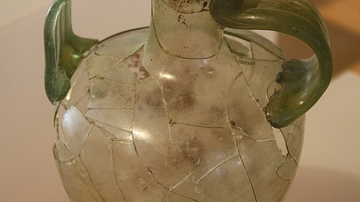
Roman Two-Handled Glass Vase
A Roman two-handled glass vessel. 4th century CE, from the Necropolis de l'Avinguda de la Constitucio, Valencia. (Archaeological Museum, Valencia, Spain)
Image
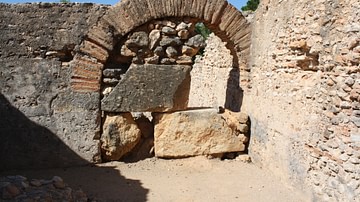
Roman Baths Furnace
The remains of the furnace which heated the private baths at the Roman villa of Els Munts, Tarraco (Tarragona, Spain). 1st century CE.
Image
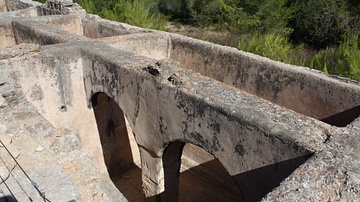
Roman Water Reservoir
A large water reservoir from the Roman Villa of Els Munts, Tarraco (Tarragona, Spain). 1st century CE.
