
Search Images
Browse Content (p. 1501)
Image
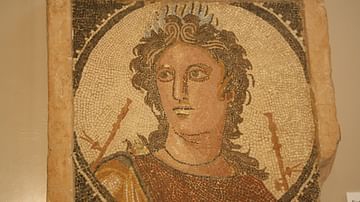
Roman Mosaic of Euterpe
A Roman mosaic of Euterpe, the Muse of lyric poetry, from Tarraco. 2nd century CE. (Archaeological Museum, Tarragona, Spain)
Image
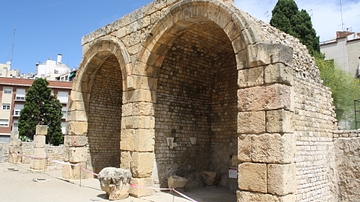
Roman Tabernae, Tarraco
Partially reconstructed tabernae (shops) in the Roman Forum of Tarraco (Tarragona, Spain). The Forum was in use from the 1st to 4th century CE.
Image
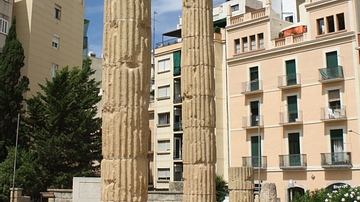
Roman Basilica, Tarraco
Columns of the 1st century CE Basilica in the Roman Forum of Tarraco (Tarragona, Spain).

Image
Denarius of Augustus with Crocodile
A Roman silver denarius coin depicting a crocodile and the legend AEGVPTO CAPTA. Reign of Augustus commemorating his victory in Egypt, 28-6 BCE. (Archaeological Museum, Tarragona, Spain)
Image
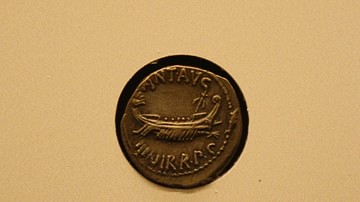
Praetorian Galley
A Roman coin depicting a praetorian galley. Silver denarius of Mark Antony, 32-31 BCE. (Archaeological Museum, Tarragona, Spain)

Image
Roman Citizen Voting
A Roman coin depicting a citizen voting, silver denarius of L. Cassius Longinus, 63 BCE.
Archaeological Museum, Tarragona, Spain.
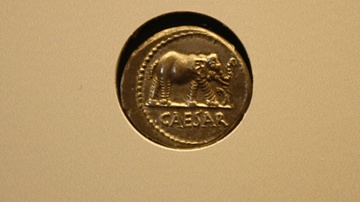
Image
Coin of Julius Caesar with Elephant
A silver denarius of Julius Caesar depicting an elephant commemorating his victory over the Gauls and Germanic tribes in 58 BCE. (Archaeological Museum, Tarragona, Spain)

Image
Roman Coin with Soldiers
A Roman coin depicting two standing soldiers. Denarius of Caius Servilius, 1st century BCE. (Archaeological Museum, Tarragona, Spain)

Image
Roman Toga, Tarragona
A marble statue of a figure wearing a toga from the Scaenae frons of the Roman theatre of Tarragona. 1st century CE. (Archaeological Museum, Tarragona, spain)

Image
Tang Dynasty Standing Buddha
Marble standing Buddha with pigments. 70 cm (height). Tang Dynasty, 600s-700s CE. Excavated from Liquan Monestery at Liquan County, Xianyang, 1987 CE. From the Xi'an Museum. (Photo taken at the Art Gallery of NSW, Sydney...
