
Search Images
Browse Content (p. 1525)

Image
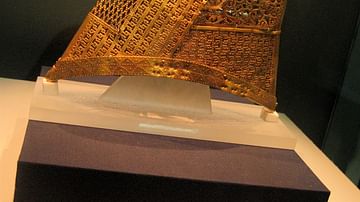
Gold Silla Crown Ornament
A wing-like ornament, probably to be worn with a gold Silla crown. The wings are decorated with over 400 small gold spangles. From the Cheonmachong or 'Heavenly Horse Tomb', Gyeongju. 6th century CE. National Treasure...
Image
Gold Silla Cap
A gold Silla crown cap from Cheonmaching (the 'Heavenly Horse Tomb'), Gyeongju, Korea. It is made from four gold plates bent and riveted together. 6th century CE. National Treasure No. 189. (Gyeongju National Museum, South Korea...
Image
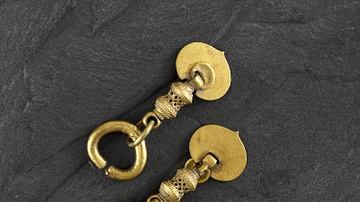
Silla Gold Earrings
A pair of gold earrings from the Silla kingdom of ancient Korea, 5th-6th century CE. (British Museum, London)

Image
Silla Gold Crown
A gold crown of the Silla kingdom, Korea. From the Auspicious Phoenix Tomb, Geumseong (Gyeongju), 5-6th century CE. The crown is made of sheet-gold and decorated with granulation and crescent-shaped jade pendants. The tree-like...
Image
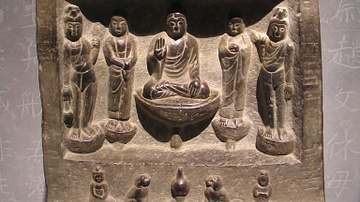
Balhae Stele Depicting Buddha
A stele from the Balhae kingdom depicting a seated Buddha. 698-926 CE. (National Museum of Korea, Seoul, South Korea)
Image
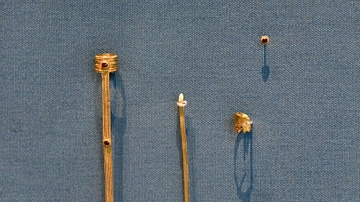
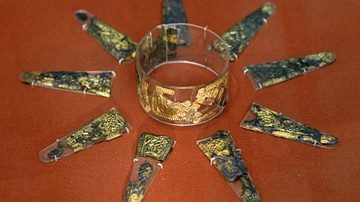
Gold Mounts from Sutton Hoo
These enigmatic mounts may have been emblems of office. Rivets and rivet-holes show that some were attached to other objects, perhaps bone or ivory rods that decayed in the ground. The most elaborate mount comprises a...
Image
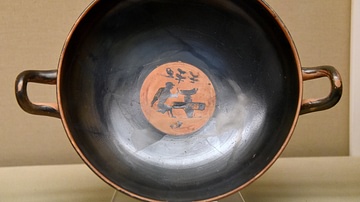
Kylix Depicting a Potter
The potter's wheel remains stationary as the potter leans forwards to attach the handle to the cup. On the shelf above him are four kylixes in two piles, and an oinochoe (wine-jug). The figure below the wheel is probably...

Image
Roman Lead Weight Decorated with Cornucopia
This lead weight was decorated with a terminal figure, cornucopia (horn of plenty), and an ear of barley. The weight is dated to the 4th year of a Hellenistic king. It is a standard mna (half stater) of a...
Image
Fragments of a Maple Wood Vessel from Sutton Hoo
These fragments are from a set of six maple wood bottles or flasks, perhaps used for medium-strength alcoholic drinks, like mead or ale. Maple trees were uncommon in East Anglia, so their wood may have...

Image
The Muse Casket from the Esquiline Treasure
This elaborate cosmetics box, suspended on three chains, holds five small canisters for perfumes and unguents. The outside is decorated with images of eight of the nine classical Muses. A 9th figure on the...
