
Search Images
Browse Content (p. 1553)
![Opus Sectile Flooring [Rosettes]](https://www.worldhistory.org/img/c/p/360x202/5534.jpg?v=1599422403)
Image
Opus Sectile Flooring [Rosettes]
A section of Roman opus sectile flooring. Marble, 1st century CE, urban quarter of Tarraco (Tarragona), Spain. (Archaeological Museum, Tarragona).
Image
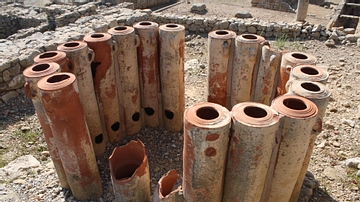
Ground Water Filter, Empuries
A terracotta ground water filter, in situ. 3rd century BCE, Greek Empuries (Emporion or Emporiae), Spain.
Image
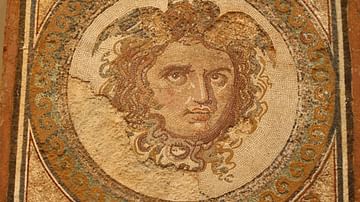
Medusa Mosaic
A Roman mosaic emblemata depicting Medusa. 2nd-3rd century CE, Tarraco (modern Tarragona), Spain. (Archaeological Museum, Tarragona)

Image
Amphorae
Various amphorae excavated at Roman Tarraco (Tarragona), Spain. 1st century BCE to 6th century CE. (Archaeological Museum, Tarragona)
Image
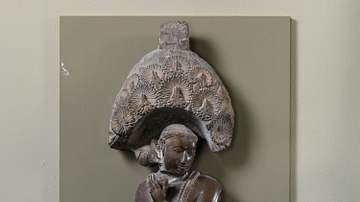
Gandharva
Celestial Musician (Gandharva), Western Chalukyan period, 11th century CE, India (Karnataka, possibly Dharwar). (The Metropolitan Museum of Art, New York)

Image
The Kurukshetra War
A scene depicting the two opposing armies of the Pandavas and the Kauravas (left) in the Kurukshetra War of the epic Mahabharata. (1700 CE watercolour, Mewar, India)
Image
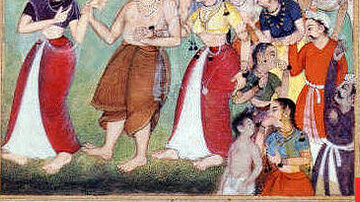
Gandhari & Dhritarashtra
Kunti leads the blindfolded Gandhari and a blind Dhritarashtra, parents of the 100 Kauravas, into exile in a scene from the Mahabharata. 16th century CE print by Dhanu.
Image
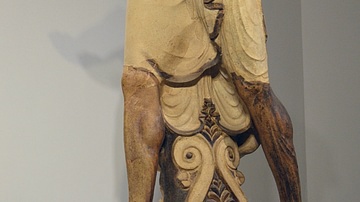
Apollo of Veii
Large scale terracotta sculpture depicting the Apollo of Veii (the Etruscan Aplu). From the roof of the Portonaccio Temple at Veii (Italy), around 510 BCE. (National Etruscan Museum of Villa Giulia, Rome)
Image
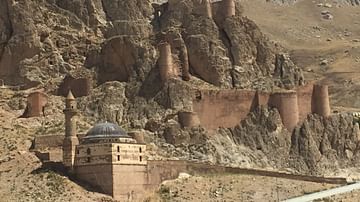
Urartian Fortress & Tomb
The ruins of this fortress (Bayazit Kalesi) and tomb date back to the 9th century BCE Kingdom of Urartu just outside present-day Dogubayazit, Turkey. The Kingdom of Urartu was centered in modern-day eastern Turkey, southwest...

Image
Amphorae Packed for Transportation
A reconstruction showing how amphorae were packed in sailing vessels for transportation across the ancient Mediterranean. (Empuries Archaeological Site Museum, Spain)
