
Search Images
Browse Content (p. 1688)
Image
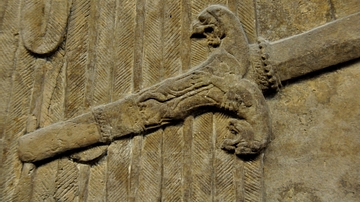
Assyrian Sword Sheath
A close-up image of the lower end of an Assyrian sword's sheath.The sheath's end has been decorated with bodies of 2 roaring lionesses. The sword depicted on this alabaster bas-relief belongs to an Assyrian attendant and...

Image
Tribute Bearers Before Ashurnasirpal II
This alabaster bas-relief was placed on the facade of the throne room. It depicts 2 men as tribute bearers. The one of the left wears a turban of a kind worn in the north-west Syrian territories; he raises his...
Image
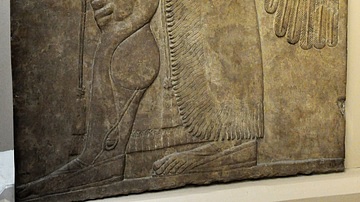
An Assyrian Apkallu Carrying a Goat
This alabaster bas-relief depicts a human-headed and winged man, Apkallu or Sage, carrying a goat. He wears a sandal carries a goat with his left arm and what appears to be a palm branch in his right hand. Note...
Image
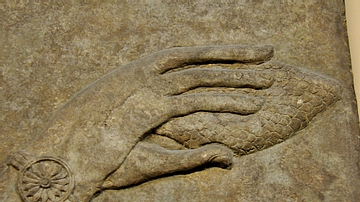
Assyrian Mullilu
This is a close-up image of a hand carrying an Assyrian mullilu; mullilu is an Akkadian word which means a purifier. This object, most likely a pine cone, was dipped into a certain liquid and then sprinkled on the Assyrian king...
Image
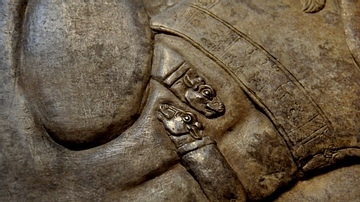
Assyrian Armlet
A close-up view of the right arm of a human-headed and winged protective spirit, Apkallu (or Sage). There is an armlet which embraces the right biceps muscle. The armlet's ends are sheep-headed. Note the decorations on the lower...
Image
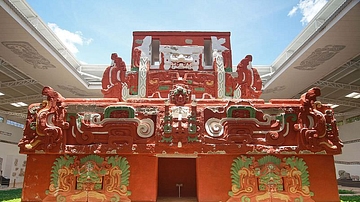
Rosalila Temple, Copan
A reconstruction of the Maya temple known as the Rosalila, excavated from within Structure 16 at Copan. c. 8th century CE.
Image
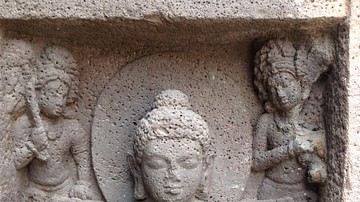
Seated Buddha Figure Displaying Dharmachakra Mudra
Here, the figure seated in the lotus position features two important details: first, a halo, indicating that Prince Siddhartha has attained Enlightenment and so has become the "Buddha", or the Enlightened...

Image
The Cliffs of Moher, County Clare, Ireland
The Cliffs of Moher are on the west coast of Ireland and reach 214m (702 feet) at their highest point. On a clear day one can see the Aran Islands, Galway Bay, the Twelve Pins, the Maum Turk mountains in...

Image
Staircase, Pyramid of Kukulcan, Chichen Itza
The Castillo or Pyramid of Kukulcan at the Maya (and possibly later Toltec) centre of Chichen Itza, Yucatan, Mexico. The pyramid was a temple built in honour of the Maya feathered-serpent god Kukulkan, pre-11th...

Image
Wall Carving, Ajanta Cave Complex
Wall carving in one of the inner caves of the Ajanta cave complex, an ancient Buddhist monastery and UNESCO World Heritage Site located in the Aurangabad District of Maharashtra, India. Originally built in approximately...
