
Search Images
Browse Content (p. 1793)
Image
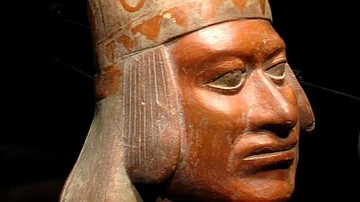
Moche Ceramic Portrait
A ceramic portrait vessel from the Moche civilization of ancient Peru (1 CE - 700 CE). Such spouted vessels are typical of Moche pottery and are considered to be realistic portraits of real people. (Musée du quai Branly...

Image
Semiramis
Semiramis by William Wetmore Story, 1872-3, Dallas Museum of Art. Photo by Mark Carroll Photography, All Rights Reserved. (Used by permission of Mark Carroll Photography.)
Image
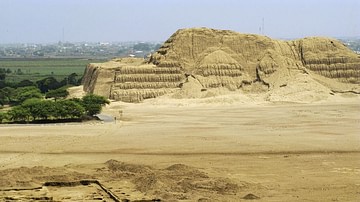
Huaca del Sol, Moche
The remains of the Huaca del Sol pyramid at Moche, Peru. The huge ceremonial mound had four tiers and was constructed using over 140 million adobe bricks. Reaching a height of 50 metres, the site was used for religious and...

Image
Tu Marcellus eris
Painting by Jean Auguste Dominique Ingres, 1812 CE, Royal Museum of Fine Arts, Belgium. In the Aeneid, Aeneas sees Marcellus in the Underworld and is saddened by Marcellus' early death. When this passage is read to Augustus (Marcellus'...

Image
Aristippus of Cyrene
Aristippus in Thomas Stanley's "History of Philosophy", 1655 CE.

Image
Head of a Ruler
Head of a Ruler, 2300-2000 BCE, Mesopotamia or Iran, now in the Metropolitan Museum of Art, New York
Image
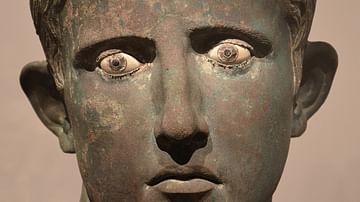
Bronze Head of Augustus
Bronze head from an over-life-sized statue of Augustus, found in the ancient Nubian site of Meroë in Sudan, 27 - 25 BCE. On display in the British Museum, London.

Image
Augustus as pontifex maximus
Marble statue of Augustus as Pontifex Maximus, late Augustan period. (Palazzo Massimo alle Terme, Rome)

Image
Equestrian statue of Augustus
Bronze torso from an equestrian statue of Augustus dating from the end of the 1st century BCE. The statue was found in the sea between Euboia and Agios Eustratios. (National Archaeological Museum of Athens)

Image
Spartacus 1960 Film Poster
The original release poster for the 1960 film Spartacus starring Kirk Douglas and Laurence Olivier. Artist: William Reynold Brown.
