
Search Images
Browse Content (p. 403)
Image
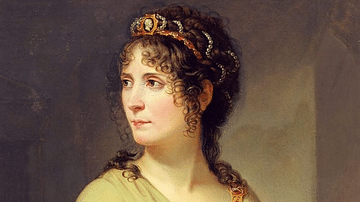
Portrait of Joséphine de Beauharnais
Portrait of Joséphine de Beauharnais (1763-1814) later in life. By Andrea Appiani, c. 1808.
Private collection.

Image
The Three Graces by Antonio Canova
The Three Graces, statue by Italian sculptor Antonio Canova, commissioned at the behest of Empress Joséphine de Beauharnais, c. 1813-1816.
Hermitage Museum, St. Petersburg.
Image
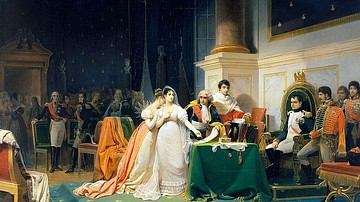
The Divorce of Napoleon and Joséphine
The divorce of Empress Joséphine and Emperor Napoleon, 10 January 1810. Oil on canvas, by Henri Frédéric Schopin, 1843.
Wallace Collection, London.
Image
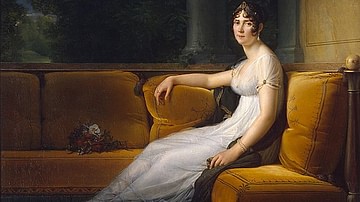
Joséphine de Beauharnais at Malmaison
Joséphine de Beauharnais at her personal residence of Malmaison, oil on canvas by François Gérard, 1801.
Hermitage Museum, St. Petersburg.
Image
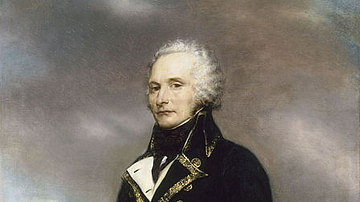
Portrait of Alexandre de Beauharnais
Portrait of Alexander de Beauharnais, oil on canvas by Georges Rouget, 1834.
Palace of Versailles.
Image
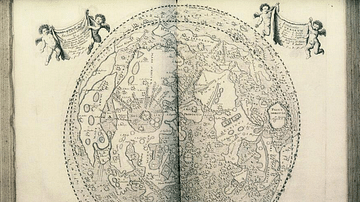
Hevelius' Map of the Moon
A map of the Moon's surface drawn in 1647 by Johannes Hevelius (1611-1687), the Polish astronomer. (Bodleian Library, Oxford)

Image
Hevelius & Elisabeth Using a Sextant
A 1673 print showing Johannes Hevelius (1611-1687), the Polish astronomer, and his wife Elisabeth examining the stars using a sextant. From Hevelius's Machinae Coelestis: Pars Prior, (1673), fig. M, facing p. 222...

Image
Johannes Hevelius by Schultz
A 1677 portrait by Daniel Schultz of Johannes Hevelius (1611-1687), the Polish astronomer. (Library of Polish Academy of Sciences, Gdańsk)
Image
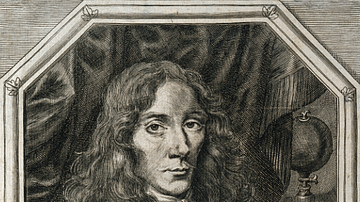
Robert Boyle Portrait
An engraving portrait of Robert Boyle (1627-1691), the Anglo-Irish chemist, physicist, and experimental philosopher. In the background is the scientist's celebrated air pump.
Image
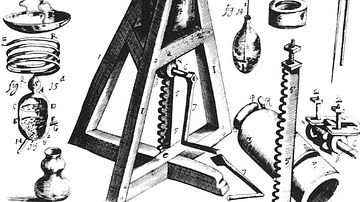
Boyle's Air Pump
The air pump commissioned by Robert Boyle (1627-1691) and built by Robert Hooke (1635-1703). The instrument was unique in that it allowed specimens to be placed in the glass ball and subjected to different air pressures. From...
