
Search Images
Browse Content (p. 409)
Image
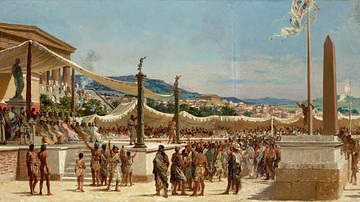
Titus Quinctius Flamininus Offers Liberty to the Greeks
Titus Quinctius Flamininus declares Greece free after the Second Macedonian War and the defeat of Philip V of Macedon at the Battle of Cynoscephalae (197 BCE), oil on canvas by Giuseppe Sciuti...
Image
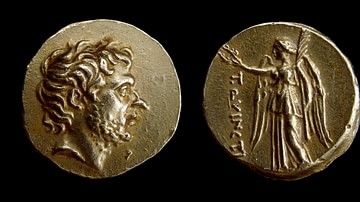
Gold Coin of Titus Quinctius Flamininus
Gold stater in the name of Titus Quinctius Flamininus, probably issued in the wake of the victory at the Battle of Cynoscephalae (197 BCE), minted in Greece, 196 BCE.
The British Museum, London.
Image
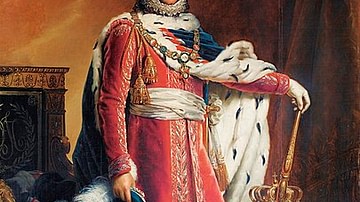
Joachim Murat as King of Naples
Portrait of Joachim Murat as King of Naples (r. 1808-1815), oil on canvas by François Gérard, c. 1811.
Private collection.
Image
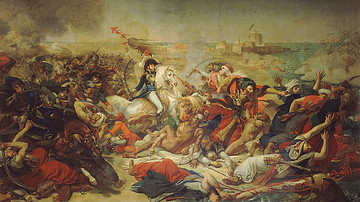
Murat at the Battle of Aboukir, July 1799
Joachim Murat leads a cavalry charge against the Ottoman Turks at the Battle of Aboukir, during Napoleon's Campaign in Egypt and Syria, in July 1799. Painting by Antoine-Jean Gros, 1807. Palace of Versailles...
Image
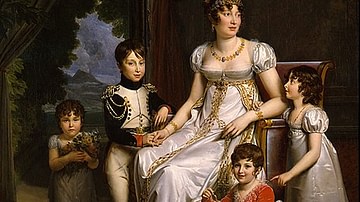
Caroline Bonaparte and Her Children
A portrait of the Murat family: Caroline Bonaparte, Queen of Naples and wife of Joachim Murat, sits in the center of her four children. The children include Achille Murat, Lucien Murat, Luisa Murat, and Letizia...
Image
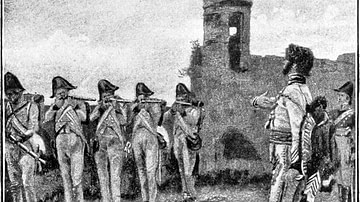
Execution of Murat by Firing Squad, October 1815
Execution of Joachim Murat, former French marshal and King of Naples, by firing squad, 13 October 1815. Image from the book Patria Esercito Re by Leopoldo Pullè, 1908.

Image
Royal Society Copley Medal
An example of a Copley Medal, the oldest medal awarded by the Royal Society for making an outstanding contribution to the field of scientific knowledge, first issued in 1731.
Image
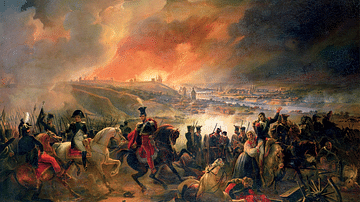
Battle of Smolensk, 1812
French Emperor Napoleon I and Prince Józef Poniatowski leading troops during the Battle of Smolensk (16-18 August 1812), painting by Jean-Charles Langlois, 1839. The burning city is visible in the background. Palace of...
Image
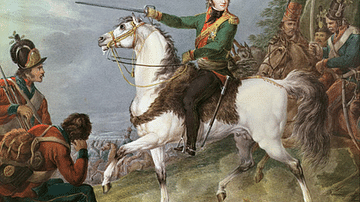
Prince Poniatowski Leading Polish Troops in the 1790s
Prince Józef Poniatowski leading Polish troops during the wars of the 1790s, painting by Aleksander Orłowski, c. 1809-1813.
Private collection.
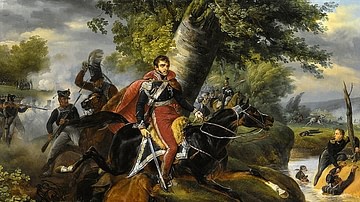
Image
Death of Prince Poniatowski
The death of Prince Józef Poniatowski on 19 October 1813, during the Battle of Leipzig. Oil on canvas by Horace Vernet, 1816.
