
Search Images
Browse Content (p. 468)

Image
Pergamon, Asklepieion
Sanctuary of Asclepius, Asklepieion of Pergamon.
Image
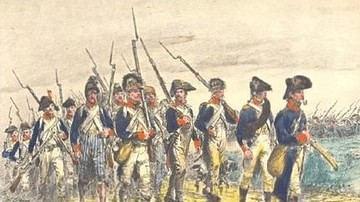
Soldiers of the Armée de Sambre-et-Meuse
Soldiers of the Armée de Sambre-et-Meuse by Édouard Detaille, c. 1880.
Image
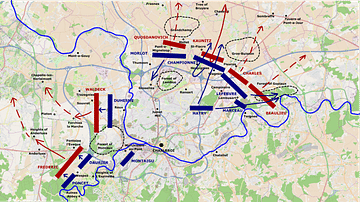
Battle of Fleurus, 1-5 p.m.
A map depicting the final maneuvers in the Battle of Fleurus (26 June 1794) from around 1 p.m. to 5 p.m. Map by Talamioros, with OpenStreetMap, December 2021.
Image
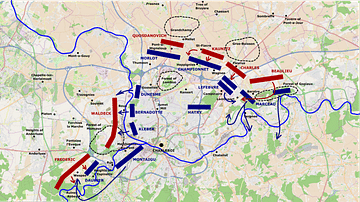
Battle of Fleurus, 10 a.m. to 1 p.m.
A map depicting the maneuvers in the Battle of Fleurus (26 June 1794) from around 10 a.m. to 1 p.m. Map by Talamioros, with OpenStreetMap, December 2021.
Image
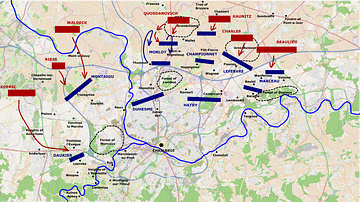
Battle of Fleurus, Daybreak to 8 a.m.
A map depicting the opening maneuvers in the Battle of Fleurus (26 June 1794) from daybreak to 8 a.m. Map by Talamioros, with OpenStreetMap, December 2021.
Image
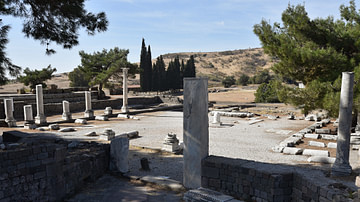
Entrance Courtyard, Asklepieion of Pergamon
View of the entrance courtyard of the Asklepieion of Pergamon sacred area. It was a large courtyard of 120 x 90 m surrounded by galleries with columns (stoa) on three sides.
Image
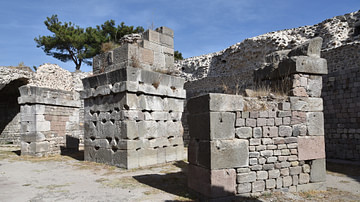
Treatment Building, Asklepieion of Pergamon
The Treatment Building centre (also known as the Temple of Telesphorus) of the Asklepieion of Pergamon was a circular structure with two floors and a 70m-long underground passage connecting it to the sacred...
Image
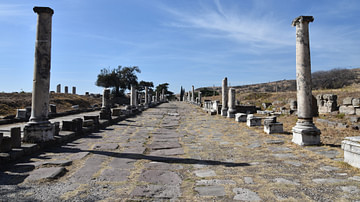
Sacred Way, Asklepieion of Pergamon
The connection between Pergamon city and the sacred area of Asklepieion was provided through a sacred road of 1 km built during the Roman Empire period. The sacred road had arches and was covered with vaults.
Image
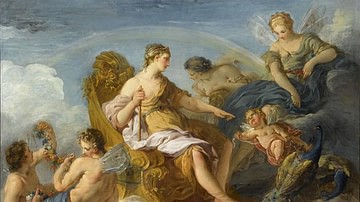
Juno, Iris, and Flora
Juno, Iris, and Flora, oil on canvas by François Lemoyne, 1720s.
Louvre, Paris.
Image
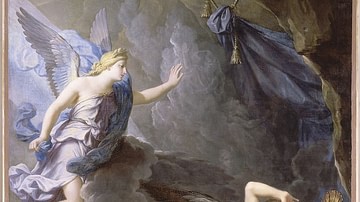
Morpheus Awakening as Iris Draws Near
Morpheus Awakening as Iris Draws Near, oil on canvas by René-Antoine Houasse, 1690.
Palace of Versailles.
