
Search Images
Browse Content (p. 765)
Image
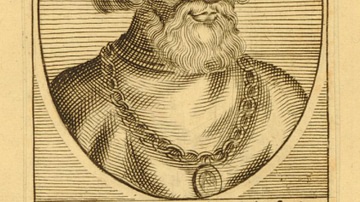
Portrait of Louis the Pious
17th-century portrait of Louis the Pious, Holy Roman Emperor and King of the Franks (r. 814-840), by an unknown creator, c. 1610-1640.
The British Museum, London.
Image
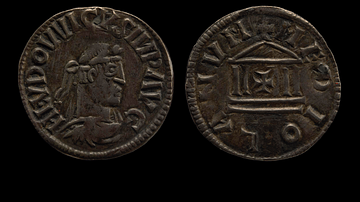
Coin Depiction of Louis the Pious
9th-century silver coin depicting Louis the Pious, Holy Roman Emperor and King of the Franks (r. 814-840).
The British Museum, London.
Image
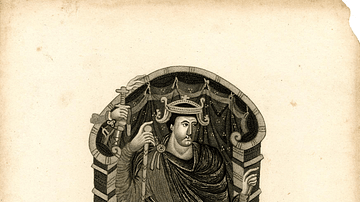
Illustration of Lothar I, Holy Roman Emperor
Illustration of an enthroned Lothar I, Holy Roman Emperor (r. 840-855), King of Middle Francia (Lotharingia) and Italy (r. 843-855). Copied by G.W. Hutin, 1821, from a 9th-century manuscript of the Gospels...
Image
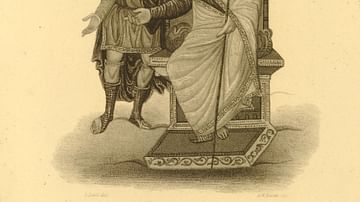
Illustration of Charles the Bald, Holy Roman Emperor
Illustration of an enthroned Charles the Bald, Holy Roman Emperor (r. 875-877 CE), King of West Francia (r. 843–877) and Italy (r. 875–877). Copied by G.W. Hutin, 1821, from a 9th-century manuscript...

Image
Emperor Charles the Fat & King Louis III the Younger of East Francia
Engraved portrait of Kings of East Francia Charles the Fat (r. 876-887 CE), Holy Roman Emperor (r. 881-887 CE), and Louis III the Younger (r. 876-882 CE), by unknown creator, c. 1634-1643...

Image
Arch of Hadrian, Athens
The Arch of Hadrian in Athens was built in 131/132 CE by the Athenians in honor Hadrian (r. 117-138 CE) for his many benefactions to the city. One of the two inscriptions carved on the architrave of the arch names Hadrian...

Image
Grand Staircase, RMS Titanic
A reconstruction of the Grand Staircase on RMS Titanic which sank on its maiden voyage on 15 April 1912 after hitting an iceberg in the Atlantic. The staircase had a domed glass roof, went down seven decks, and provided...

Image
A First-Class Stateroom, RMS Titanic
A reconstruction of a first-class stateroom on RMS Titanic which sank on its maiden voyage on 15 April 1912 after hitting an iceberg in the Atlantic. (From The Titanic Experience exhibition, Orlando, Florida)

Image
Edward J. Smith, Captain of the Titanic
A photograph of Edward J. Smith, captain of RMS Titanic which sank on 15 April 1912 after hitting an iceberg in the Atlantic.
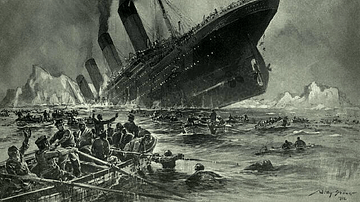
Image
Sinking of the Titanic by Stöwer
A 1912 engraving by Willy Stöwer showing the sinking of RMS Titanic on 15 April 1912 in the Atlantic after hitting an iceberg.
