
Search Images
Browse Content (p. 953)
Image
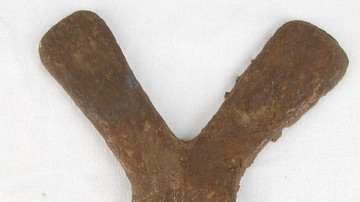
Copper Curency Ingot, Luba Kingdom
A copper cross used as a currency by such central African states as the Kingdom of Luba (15-19th century CE). Height: 19.5 cm. (British Museum, London)

Image
Thucydides Mosaic
Thucydides Mosaic from Jerash, Jordan.
Roman, 3rd century CE, Pergamon Museum, Berlin.

Image
Ancient Roman Marketplace
An artist's impression of what life on an ancient Roman forum (marketplace) would look like. Image by Mateusz Przeklasa, reproduced with permission courtesy of Ancient History Magazine / Karwansaray Publishers.

Image
Château Gaillard, Les Andelys - Reconstruction
This animation shows the ruins of Château Gaillard (Les Andelys, France) being reconstructed to what it might have looked. The castle was first built in 1196 CE by Richard I of England. Created by NeoMam...
Image
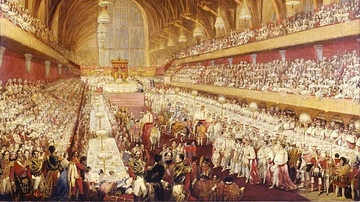
Coronation Banquet of George IV, Westminster Hall
An oil painting of the sumptuous coronation banquet of George IV of England (r. 1820-1830 CE) in Westminster Hall in 1821 CE. (Museum of London)
Image
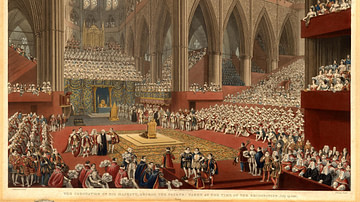
The Coronation of George IV, Westminster Abbey
An illustration showing the interior of Westminster Abbey during the coronation ceremony of George IV of England (r. 1820-1830 CE) in 1821 CE. (National Portrait Gallery)

Image
Evening Reading
Autumn Evening Reading

Image
Roman Defeat
Artist's impression of a Roman defeat.

Image
Danse Macabre in St. Mary's Church, Beram
"Dance of the Dead" fresco from the Church of St. Mary in Beram, Croatia. Painted by Vincent of Kastav, 1471. Artwork depicting the "Danse Macabre" motif became popular in Europe after the Black Death.
Image
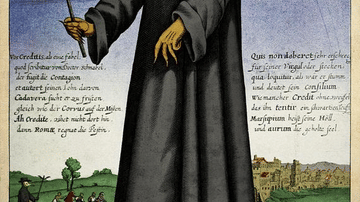
17th-century Depiction of Plague Doctor
A depiction of "Doctor Schnabel" ("Schnabel" is literally German for "Beak"), a plague doctor in Rome. The illustration appeared in a 17th -century German satirical manuscript. The engraving was first published...
